@LovelyPL https://www.bristol.ac.uk/physics/research/astrophysics/areas/exoplanet-atmospheres/
>To measure the atmosphere, we observe the transit of the exoplanet as it passes in front of its star, this causes a small dimming effect on the measured starlight which corresponds to the relative size of the planet. If the planet has an atmosphere surrounding it, some of the star's light will be filtered through the exoplanet atmosphere before reaching the telescope. Each atom and molecule have its own unique spectral fingerprint. If an atom or molecule is present in the exoplanet's atmosphere it will imprint its signature on the spectrum of the starlight which can be measured to determine the atmospheric composition.
A o wietrze napisała NASA tutaj, przy innej gwieździe
https://science.nasa.gov/universe/exoplanets/5400mph-winds-discovered-hurtling-around-planet-outside-solar-system/
>Louden explained: “HD 189733 b’s velocity was measured using high resolution spectroscopy of the sodium absorption featured in its atmosphere. As parts of HD 189733 b’s atmosphere move towards or away from the Earth the Doppler effect changes the wavelength of this feature, which allows the velocity to be measured.”
>
>Explaining how this information was used to measure velocity Louden said, “The surface of the star is brighter at the center than it is at the edge, so as the planet moves in front of the star the relative amount of light blocked by different parts of the atmosphere changes. For the first time we've used this information to measure the velocities on opposite sides of the planet independently, which gives us our velocity map.”
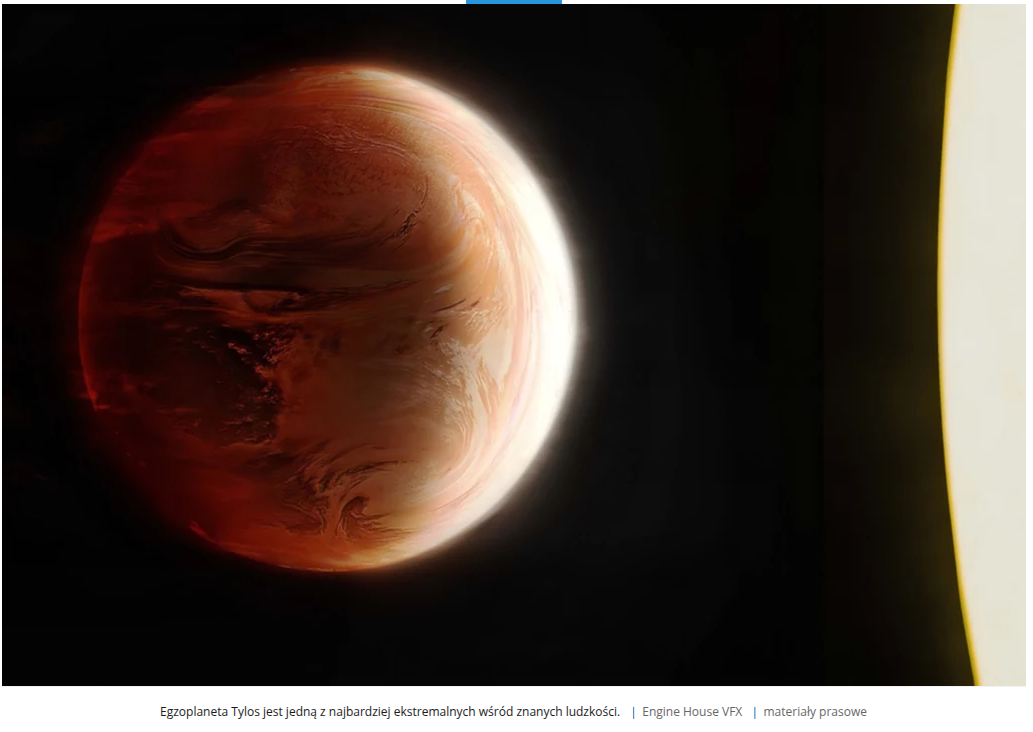
W skrócie: zdjęć raczej nie zobaczysz, bo nikt tego tych zdjęć za bardzo nie ogląda, tylko raczej patrzą na wykresy danych, jakiego koloru było najwięcej w danej chwili i przy użyciu jakich filtrów.
Gołym okiem to "gówno widać", różnice jasności/barw zauważalne jedynie dla maszyny
Exoplanet Atmospheres | School of Physics | University of BristolBristol
%22%2F%3E%3Ctext%20x%3D%2250%22%20y%3D%2250%22%20dy%3D%220.35em%22%20text-anchor%3D%22middle%22%20font-family%3D%22system-ui%2Csans-serif%22%20font-size%3D%2248%22%20font-weight%3D%22700%22%20fill%3D%22hsl(24%2060%25%2092%25)%22%3EK%3C%2Ftext%3E%3C%2Fsvg%3E)
%22%2F%3E%3Ctext%20x%3D%2250%22%20y%3D%2250%22%20dy%3D%220.35em%22%20text-anchor%3D%22middle%22%20font-family%3D%22system-ui%2Csans-serif%22%20font-size%3D%2248%22%20font-weight%3D%22700%22%20fill%3D%22hsl(280%2060%25%2092%25)%22%3EB%3C%2Ftext%3E%3C%2Fsvg%3E)
%22%2F%3E%3Ctext%20x%3D%2250%22%20y%3D%2250%22%20dy%3D%220.35em%22%20text-anchor%3D%22middle%22%20font-family%3D%22system-ui%2Csans-serif%22%20font-size%3D%2248%22%20font-weight%3D%22700%22%20fill%3D%22hsl(150%2060%25%2092%25)%22%3EL%3C%2Ftext%3E%3C%2Fsvg%3E)
%22%2F%3E%3Ctext%20x%3D%2250%22%20y%3D%2250%22%20dy%3D%220.35em%22%20text-anchor%3D%22middle%22%20font-family%3D%22system-ui%2Csans-serif%22%20font-size%3D%2248%22%20font-weight%3D%22700%22%20fill%3D%22hsl(45%2060%25%2092%25)%22%3EG%3C%2Ftext%3E%3C%2Fsvg%3E)
%22%2F%3E%3Ctext%20x%3D%2250%22%20y%3D%2250%22%20dy%3D%220.35em%22%20text-anchor%3D%22middle%22%20font-family%3D%22system-ui%2Csans-serif%22%20font-size%3D%2248%22%20font-weight%3D%22700%22%20fill%3D%22hsl(210%2060%25%2092%25)%22%3ED%3C%2Ftext%3E%3C%2Fsvg%3E)






 LovelyPLFenomen


 AtexorFanatyk
 SofieOsobistość


 Szlachetkin_SzalonyWirtuoz








 kermelanikTytan